22 January 2026
Articulated Continuations: 50 Years of SBTD Through Exhibition Catalogues – Miren Candina
Articulated Continuations: 50 Years of SBTD Through Exhibition Catalogues - by Miren Candina International Associate SBTD Member, Writer and Editor for design | stage
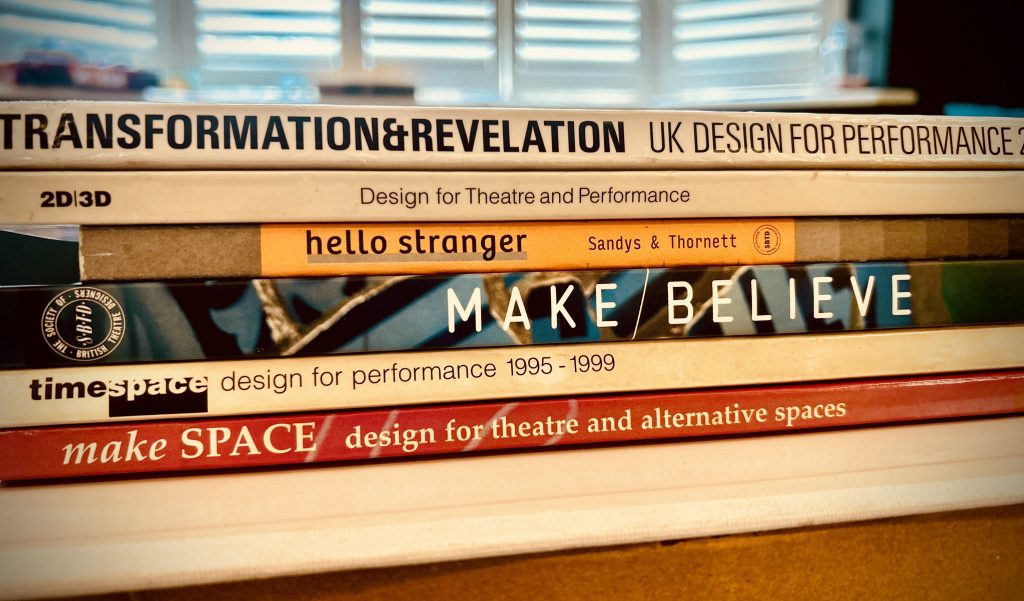
hello stranger, Make/Believe, Transformation & Revelation, Collaborators, MakeSpace!, time+space, and 2D>3D, Exploring Scenography, British Theatre Design ‘83–’87 and Staging Places as an online gallery. These are catalogues that have compiled the works of over 150 Designers and members of The Society of British Theatre Designers.
For the 50th Year of SBTD I thought it would be a good occasion to bring some of the previous catalogues into this current moment, as a recap of the projects developed and collected over the years. I understand the catalogue as a work produced at a specific moment in time, where each title is decided in relation to the timing of the exhibition. In this way, each book holds on its pages particular scenographies tied to the moment of its printing.
Collaborators: UK Design for Performance 2003-2007, held at the V&A in 2007, or Make: Believe at the Prague Quadrennial in 2015, among others. Instead, the catalogues have conveyed snapshots of what was shown in those earlier spaces, this time on paper, through the printed images that we hold as we turn the pages of the book. There we can move from one project to another and learn more about each work, each scenography, each scene, and every fragment of the image being constructed. This is not only to understand different ways of working, but to bring us closer to the work itself, with the hope of experiencing it live in future.
To begin this text about SBTD, despite not having been present at its creation, I find myself revisiting its starts; starts, in the plural, as various moments in which we step into one scenography and re-enter the next one, working from one project to another, where each new project builds on the previous one, reflecting on what came before and accumulating layers of experience. Practice here can be understood as a process of making in which doing, researching, changing, displaying, and engaging are constantly developing. Articulating the making as a continuous movement, Katie Mitchell’s advice in The Director’s Craft comes to mind: “Do not worry if you cannot see all the events to begin with. The important thing is that you have started to look for the changes in the action” (p. 56); in the act of seeing, feeling, listening, walking, swimming, or doing something that includes movement. Revisiting an image of a previous project can be a starting point to dive into the making and continue without a full understanding, but with the openness to find changes as we move forward. In that sense, catalogues organise images that allow us to return to a specific moment in the work.
Each return corresponds to the moment when we look into an image and the time we dedicate to it. I include here the word time because, among other things, it is what I sometimes find very intriguing in creative processes: working with time in relation to moving image and performance, the perception of duration, and with what Katie Mitchell calls “immediate circumstances” (p. 31); the events and conditions that immediately position the unfolding of a scene.
I am curious to see how the next design | stage exhibition will develop. At the moment there are fragments, meetings, beginnings, revisits, images, movement, light, walls, displays, textiles, colours and other narratives and realities; elements that now prompt me to write. There are questions about how to traverse a landscape, convey directions, distances and depths, and explore the limitations of the moving image or the possibilities of capturing a live event. In order to continue writing about something that we are still working on, I am returning to when the previous catalogues were printed, naming them sometimes, and in parallel, from my experience as both an audience and practitioner.
To speak about The Society of British Theatre Designers is to speak about people, the profession, and engagement. It is to speak about work among Collaborators that continuously brings something new and exciting, where one says hello stranger to a breath of fresh air. Fresh into the scenography practices, from people who believe in making, who transform scenes into real experiences, who Make:Believe.
From this constant process arises Transformation & Revelation: experiences that have the potential to transform not only the work itself but also the audience. Erika Fischer-Lichte notes that the nature of performance “consists of the bodily co-presence of actors and spectators” (p. 38). Extending this, scenographies, through their spatial presence, can also engage audiences, opening possibilities for new experience. These transformations are represented and present in the scenes held by scenographies and kept as experiences and in catalogues, where meaning is constantly emerging, revisited and re-experienced by new audiences and practitioners.
Now, let us continue Exploring Scenography and British Theatre Design with more collaborators, by becoming part of the design | stage work or by visiting it, giving time to its production, approaching it, and unfolding it; a pause that allows the articulation of the moments that follow, as Virginia Woolf captures:
“One went to the counter; one took a slip of paper; one opened a volume of the catalogue, and ….. the five dots here indicate five separate minutes of stupefaction, wonder, and bewilderment” (p. 20).
Thank you to all the collaborators who have contributed to these catalogues and SBTD. They have served as both an archive and documentation, allowing the reader not only to be closer and learn from the processes behind them, but also to keep writing new texts from those texts, and to keep doing.
Continuing, and looking forward to being around more scenographies.
———————————————————————————————————————————————————–
References:
Fischer-Lichte, E. (2008) The Transformative Power of Performance: A New Aesthetics. London: Routledge.
Mitchell, K. (2005) The Director’s Craft: A Handbook for the Theatre. London: Routledge.
Woolf, V. (1929) A Room of One’s Own. London: Penguin.
Mentioned catalogues:
Burnett, K. (ed.) (2007) Collaborators: UK Design for Performance 2003-2007. London: Society of British Theatre Designers (SBTD).
Burnett, K. (ed.) (2015) Make/Believe: UK Design for Performance. London: Society of British Theatre Designers (SBTD).
Crawley, G. (ed.) (2011) Transformation & Revelation: UK Design for Performance 2007-2011. London: Society of British Theatre Designers (SBTD).
Griffiths, M. (ed.) (2002) Exploring Scenography. London: Society of British Theatre Designers (SBTD).
O’Brien, T. and Fingleton, D. (eds.) (1987) British Theatre Design ‘83-‘87. London: Twynam Publishing.