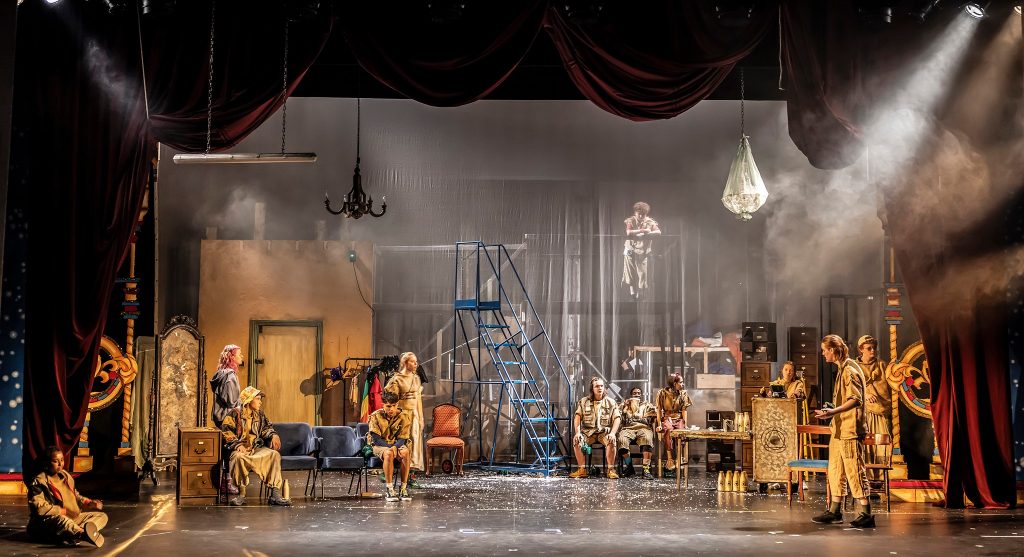
Cover Image Credit: ‘The Trails’ | Photography: Pamela Raith | Set and Costume: Maria Terry | Lighting: Laura Wolczyk | Direction: Omar Khan & Hannah Stone | Writing: Dawn King | Rocket Scenery & Jamie Smith | Sustainably Consultant: Talie Smith | Venue: Nottingham Playhouse. All images used are from Theatre Green Book Productions.
“Sustainable practice should also consider the ecosystem of the professional theatre network itself. True sustainability means ensuring that designers are adequately supported and remunerated for the time and effort this important work requires.”
Designers are committed to working sustainably, and here at the SBTD we’re proud to have a strong sustainability group. But how can directors, producers, and the wider team create the conditions for sustainable practices — such as those outlined in the Theatre Green Book — to be fully integrated into the design process? To explore this, we’ve invited sustainability experts Talie Smith and Nicholas Conde to reflect on what designers may need and how best to communicate these needs across the production network in order to achieve a truly sustainable production.
Talie Smith is a Sustainability Advisor to Theatre and Performing Arts. She is uniquely placed working with all roles in theatre to understand multiple perspectives. Her agenda is to raise awareness and lessen theatre’s impact on the climate crisis, moving towards regeneration and growth within the cultural sector.
Nicolás Conde works at the intersection of culture and sustainability, helping the performing arts adapt to a changing world. He developed a Carbon Literacy Course for regional theatres in England, contributed to the EU Alliance for a Net Positive Performing Arts Sector (INSPIRE) project, and is a lecturer at the Accademia Teatro alla Scala. His work spans Europe and Latin America, supporting artists and organisations to build the skills, confidence, and imagination needed for a just and creative transition.

This blog takes you into the heart of sustainable theatre, inviting everyone involved—directors, producers, technicians, alongside designers and more—to be part of the solution. We recognise the challenges we face in a changing climate but also celebrate the sense of shared responsibility across the industry. We are passionate advisors and practitioners, and encourage us all to weave sustainability into every conversation and creative choice. By using tools like the Theatre Green Book and the SBTD Sustainable Design Working Group‘s Materials Guide as companions on our journey, we can work together to reduce our impact and help theatre become a catalyst for positive change. The Theatre Green Book is an industry framework developed by UK theatre makers, setting out common standards and practical guidance for sustainable productions, buildings, and operations. Many designers and creatives already work sustainably in their own ways, using reclaimed materials, minimising waste, or rethinking processes, but the Green Book helps align those efforts across the sector, offering shared definitions, tools, and measurable goals.
We think that by working with this companion, creative teams can find tangible ways to turn shared intentions into everyday practice, embedding sustainability at every stage of the production journey.
Sustainable practice should also consider the ecosystem of the professional theatre network itself. True sustainability means ensuring that designers are adequately supported and remunerated for the time and effort this important work requires.
Rather than something to tackle at the end of a process, sustainability is present in every decision, every meeting, every sketch and bolt that passes through our hands. Designers already think in creative systems: they see the flow of materials, the balance between vision and resources, the team of people who bring a show to life. That perspective gives them a unique chance to set the scene for sustainability by design. But it’s never a solo act. Producers, stage managers, builders, technicians, and wardrobe teams all hold pieces of the puzzle, enabling and contributing towards collective efforts.
This map follows the timeline of a production, from invitation to afterlife. At each stage you’ll find questions to ask, actions to try, and signposts back to the Theatre Green Book. It isn’t a checklist; it’s a companion.
INVITATION & CONTRACTING
The conversation starts the moment you’re invited to join a project. This is the time to establish expectations.
- Request that the offer letter or contract includes space for sustainable practice: time for sourcing and adaptation, budget for reuse, and clarity on who is responsible for tracking data.*
- Propose a simple clause covering the target Green Book level, a stores visit, reuse targets, and an afterlife plan.
- Ask early: Would this production ideally tour or transfer?
- What resources are being committed (time, budget, staff)?
- Will elements of this design be available to others afterwards, and under what terms?
Reflections:
If you are writing a job advert, TGB intentions and aspirations can be declared here.
*The TGB Productions Tracker is a simple spreadsheet tool that supports teams in recording materials, energy use, and waste through the production process. It’s designed to help measure progress against Green Book targets and to make sustainability data transparent and shareable.
EARLY CONVERSATIONS
This is where ideas take shape and where sustainability must become part of the artistic dialogue.
- With directors: ask how climate awareness can shape the concept. In the Climate Conversations report, director and researcher Zoë Svendsen described this as developing a “climate dramaturgy”, embedding environmental awareness within the artistic and creative process.
- With producers: negotiate budgets that privilege people’s time (sourcing/adapting) over virgin materials.
- With makers and builders: start from what’s already in stock or available locally. Have conversations!
- Keep future life in mind. Would the design tour? Could elements be stored, re-used, or donated?
- How can design choices make sustainability visible, without being tokenistic?
- Are we comfortable allowing others to reuse parts of this design? What rights apply?**
- What possibilities and expectations exist around storage or redistribution after the run?
**Discussions around reusing design elements also raise important questions of copyright and creative ownership. Many designers are open to sharing materials or scenic components to support sustainability, but this must be done with clear agreements, credit, and fair remuneration. Respecting authorship and ensuring consent are key to building trust around sustainable reuse.
CREATIVE DEVELOPMENT & DESIGN
Once sketches become decisions, every choice carries weight.
- Apply the materials hierarchy reused → recycled → responsibly sourced new.
- Design for disassembly: standard fixings, modular pieces, clear labelling.
- Discuss and note in your model box or drawings where elements could or should end up after the run: store, tour, donate, recycle.
- Share early models with every department (lighting, wardrobe, props, sound) so sustainability becomes part of the collective brief and vision
- Build transport constraints into the concept: a one-truck or one-van show can be a creative provocation, not a limitation.
- Keep things simple and deliverable. Not every effort is within our possibilities, and sometimes we might need to prioritise the most impactful choices first.
- What can we borrow, hire, or repurpose instead of buy?
- What materials are off the table (PVC, polystyrene, tropical hardwoods)?
- How might climate awareness be embedded into the production’s aesthetics?
- Are there any future productions which might be able to incorporate elements from ours?
Reflections:
Think of parameters for creativity, instead of limitations. Centralised point of data collection is the TGB Productions tracker, use throughout. Repeated permission from everyone in hierarchy-artistic directors, directors and producers talking about climate care in their productions at every stage.
PROCURING & MAKING
The workshops and production meetings are where ideas meet reality.
- Work with makers and producers to prioritise reuse and hire.
- Ask what’s already on the shelves and try to incorporate.
- Encourage production to keep a materials log (you can help shape its structure).
- Where new is unavoidable, specify certified low-impact materials: FSC timber, recycled steel, water-based finishes.
- Standardise wherever possible so items can return to stock.
- Have makers been given the time to adapt reused materials?
- Are greener alternatives being explored before purchases?
- How are offcuts being separated and tracked for reuse?
Reflections:
Sourcing elements might nurture the design if we allow flexibility to incorporate them. Making notes or taking photos of this process can inform and nurture future productions or your own sustainable design journey-impact sharing!
REHEARSALS, TECH & RUN
Sustainability is sustained by habits and collaboration:
- Make it a standing item in production meetings.
- Share the sustainability plan with stage management, technicians, wardrobe, and props.
- Build routines: repair kits on hand, efficient pre-sets, reduced laundry, careful labelling.
- Support accurate data capture, learning and feedback loops
- Does everyone know their role in achieving sustainability goals?
- What simple daily habits help meet targets?
- Have we allowed enough flexibility to adapt to an organic creative journey?
Reflections:
Sharing achievements can be rewarding and incentivising for everyone involved
TOURING (if applicable)
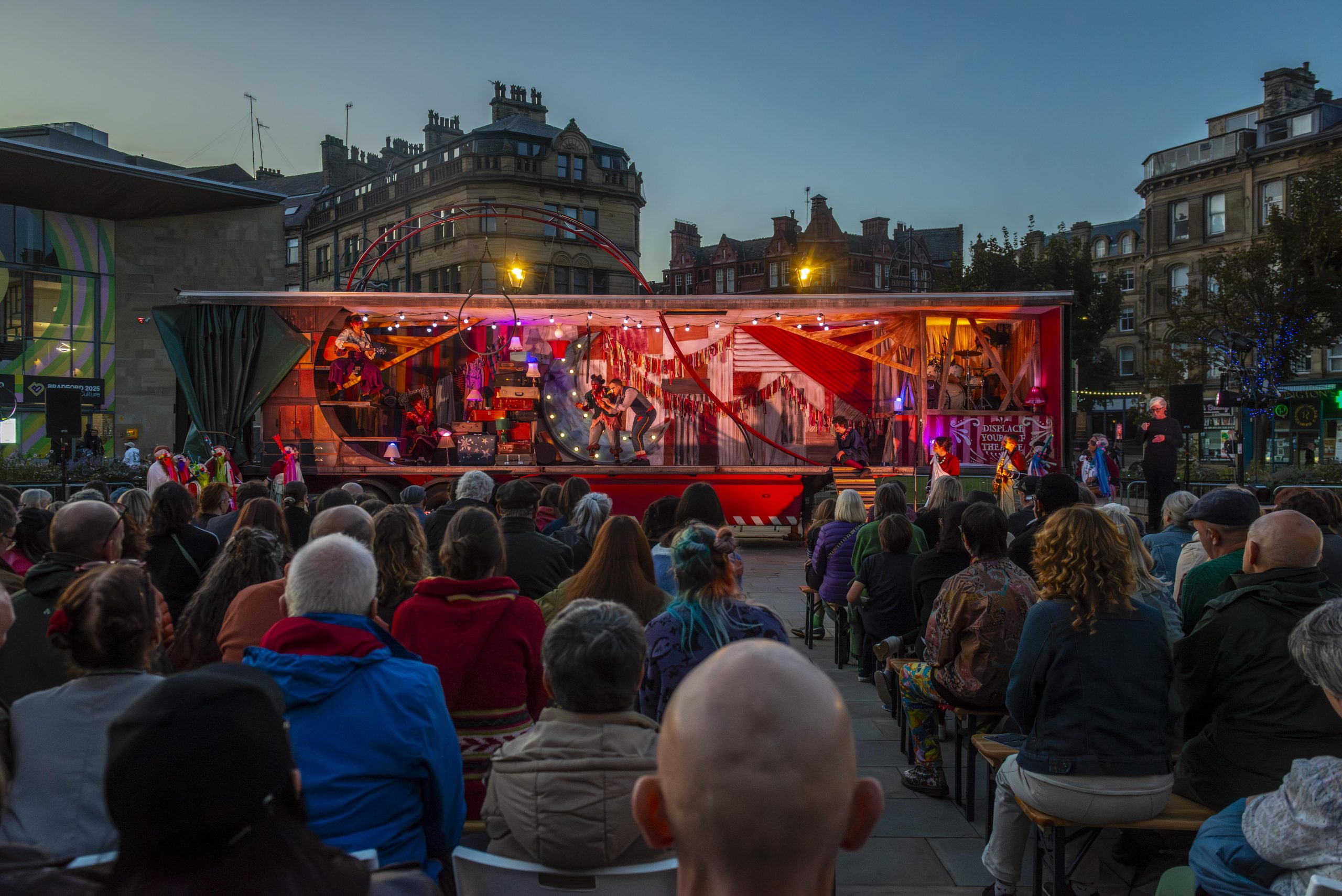
Touring magnifies impact, both positive and negative:
- Confirm transport limits and design accordingly.
- Encourage producers to source locally at each venue.
- Provide drawings and notes that make sustainable adaptation possible.
- Ensure touring riders reflect sustainability expectations.
- Explore strategies for durability and reparability on the road
- What can be sourced locally instead of transported?
- How will freight and travel data be collected and shared?
GET-OUT & AFTERLIFE
- Push for the afterlife plan to be enacted: store, donate, recycle.
- Take part in a sustainability debrief alongside the artistic one.
- Share learnings: what worked, what failed, what could shift next time.
- Clarify roles: designers propose intentions for afterlife; producers manage the transfers. Give time and budget for materials afterlife processing.
- Did we meet our targets? What blocked us, and how can that be addressed in future? Which assets or learnings should be logged for the next team?
Reflections:
Sustainability isn’t about designers doing more work. It’s about timing, asking better questions at the right time, making smarter choices, and collaborating across the production timeline. At each stage of the journey, we can set conditions that make sustainable practice the norm rather than the exception. And in doing so, we’re not just shaping productions that are imaginative and resilient, but also shaping sustainable production models by design.